
The cost of dry ice in medical courier operations
Dry ice dominates medical courier logistics, but safety liabilities, supply fragility, and hidden costs add up fast.
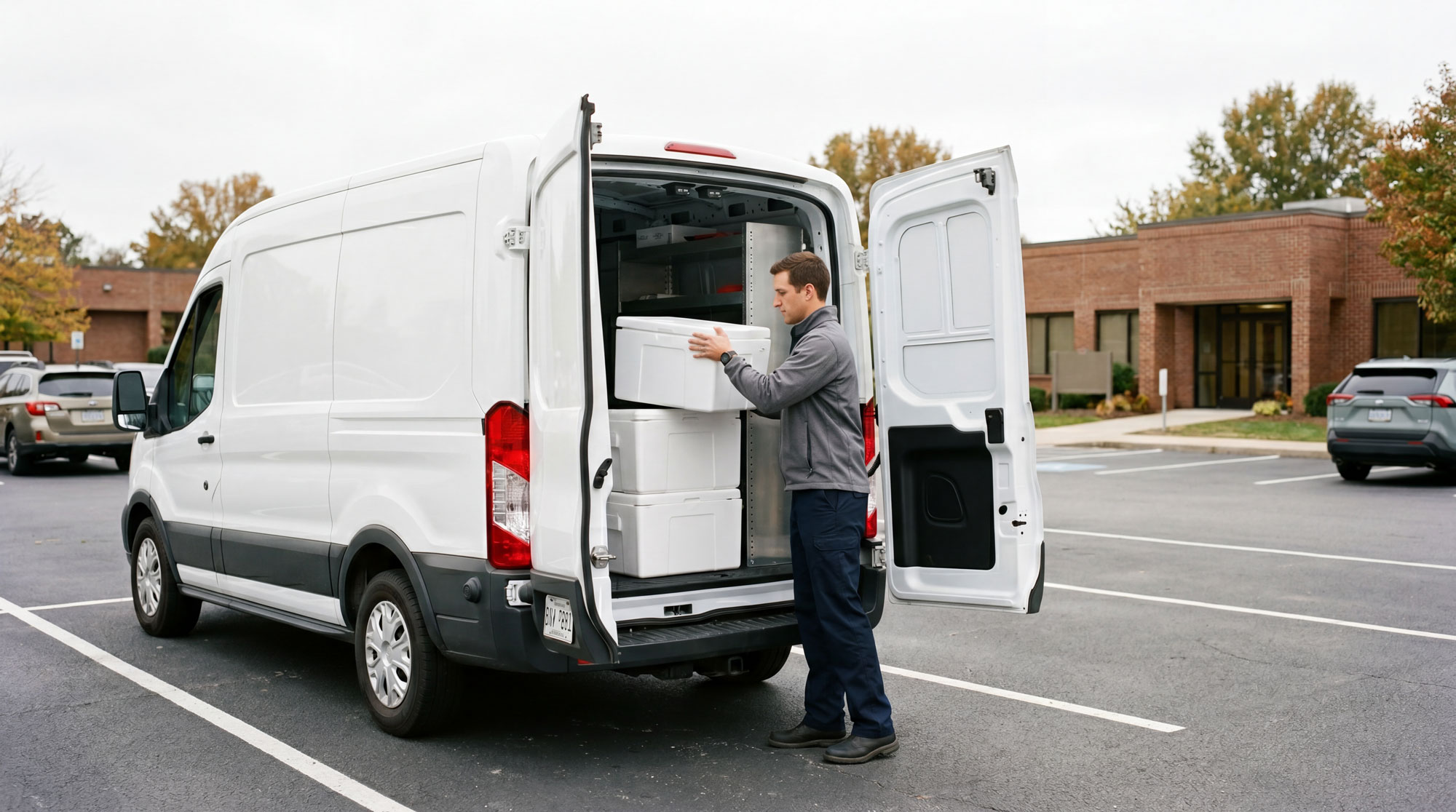
There's a ritual most medical couriers know by heart. You show up in the morning, pick up your dry ice, load the coolers, and roll the windows down. Even in February. Thirty pounds of sublimating carbon dioxide in a sealed vehicle will displace enough oxygen to make you dizzy, or worse, so the windows stay cracked and you drive cold.
Dry ice, understandably so, is the dominant cooling method in medical transport today. It's been around forever, it's genuinely reliable, and it requires no pre-conditioning cycle. You buy it, pack it, and go.
But in our experience, dry ice carries a growing stack of safety liabilities, operational overhead, and economic costs that never show up in a per-pound price comparison.
Carrying a Class 9 dangerous good every day
Under both IATA and DOT, dry ice is classified as a Class 9 miscellaneous dangerous good (UN 1845). The hazards fall into three categories: explosion risk from sublimation pressure building in sealed or poorly vented containers, suffocation risk from CO2 displacing oxygen in confined spaces like vehicle cabins, and contact injury from cryogenic frostbite on skin exposure [1][2].
The training requirements are mandatory and recurring. The part that catches people off guard is who's on the hook when something goes wrong: under 49 CFR 107.329, civil penalties for hazmat violations now run up to $102,348 per incident, and that penalty can land on the courier, not only the shipper [1][10]. The 2026 IATA Dangerous Goods Regulations formalized what many carriers were already doing in practice: vented outer packaging that permits CO2 gas release and standardized Class 9 labeling showing the UN number, hazard class, and dry ice weight on every package [3].
We've heard stories from couriers about coolers that expanded under pressure and came close to bursting. The windows-down protocol exists because oxygen displacement in an enclosed cab is a real possibility on every run. And for most couriers, this is all routine enough that it barely registers anymore.
An operational grind nobody budgets for
You have to buy dry ice every day, whether you use it all or not. The standard rule of thumb is that 5 to 10 pounds sublimates every 24 hours, and that clock starts the moment you accept delivery [4]. Any mismatch between what you forecast and what you actually need turns into waste. There's no pausing sublimation and coming back to it tomorrow.
And the form factor matters more than most people realize. Couriers handling smaller shipments typically use pellets or shaved ice rather than large blocks, because that's what fits the packaging. But research published in Engineering Reports (Hafner et al., 2024) found that pellets and chunked blocks sublimate roughly 2.5x times faster. 2.5 to 2.8% per hour, while large block formats sublimate at only 0.98 to 1.6% per hour [5]. Smaller shipments burn through their cooling faster because of the surface-area-to-volume ratio. That's a real problem if you're running smaller shipments on tight schedules.
Then there's supply. COVID exposed real vulnerabilities in the dry ice supply chain, but the structural issue hasn't gone away. Dry ice consumption has been climbing at roughly 5% annually for nearly a decade, while CO2 production capacity has grown at only 0.3% per year over the same period [6]. California alone is losing approximately 850 tons per day of CO2 capacity by early 2026 due to plant closures [6]. We've heard stories about informal secondary markets at hospitals and research facilities (people trading or hoarding dry ice when supply gets tight). That's not a stable foundation for medical logistics.
On top of all that, there's the overhead of handling it correctly: PPE for every person who touches it, specialized insulated storage, disposal protocols, and documentation requirements. Every container has to be clearly marked with the dry ice weight. Each of those steps takes personnel time, and none of them are optional.
The math nobody puts on a spreadsheet
Standard usage runs 5 to 10 pounds per 24-hour period at a retail cost of roughly $2 to $4 per pound, though most fleet operations buy in bulk at closer to $1 to $1.50 per pound [7]. At bulk rates with daily usage, a single route runs roughly $5 to $15 per day, or $100 to $300 per month. For a fleet of ten vehicles, the dry ice material cost alone lands somewhere between $12,000 and $36,000 a year.
But that number is incomplete and somewhat misleading.
If any of your legs move through a parcel carrier, the surcharges start stacking. FedEx charges $8.50 per package for dangerous goods dry ice handling, up 6.25% from $8.00 in 2025 [8]. That surcharge applies per package, per shipment. Then layer on PPE, insulated container replacement, hazmat surcharges on air shipments, the recurring training programs, and the documentation hours that come with every single run. And remember the regulatory penalty exposure from earlier: six figures per violation if something goes wrong.
None of these line items show up in a per-pound cost comparison, but they're real costs that add up across a fleet over the course of a year.
There's also the efficiency gap. The effective cooling performance of dry ice in the field, accounting for sublimation losses, imperfect insulation, and the pellet-versus-block problem from earlier, sits well below theoretical maximums. One FAA study on dry ice sublimation in common packaging configurations found significant variability depending on container type and packing method [9]. You're rarely getting the cooling performance you're paying for, especially on shorter routes where the sublimation-to-useful-cooling ratio is worst.
So what's the alternative?
We're not going to pretend dry ice doesn't work. It does. It's kept temperature-sensitive products safe for decades and it will continue to have a role in certain applications.
But the question is whether it's the right default for every medical courier route, every day, especially as the cost and complexity keep compounding and the supply keeps getting less predictable.
Battery-powered active cooling systems eliminate the daily procurement cycle, the sublimation waste, the hazmat classification, and the regulatory training burden. They're reusable, which changes the cost curve over time. And they generate data, which means you can see what happened to the product during transit.
At Artyc, the systems we've built (Medstow 5L, for instance, covering -20°C to +25°C) were designed for exactly these mid-to-last-mile courier scenarios. You charge the unit, load the product, and drive with the windows up for a change. We think the economics and the operations both point in this direction, though we also know that shifting away from something this entrenched takes time.
The first step is seeing the full picture of what dry ice actually costs, once you look past the per-pound number and start counting everything else.
Interested in seeing how active cooling compares on your routes? Talk to our team →
Sources:
[1] IATA. "2026 Acceptance Checklist for Dry Ice (Carbon Dioxide, Solid)." 2026. https://www.iata.org/contentassets/b08040a138dc4442a4f066e6fb99fe2a/en_form_dryice.pdf
[2] Amherst College Environmental Health and Safety. "Dry Ice Shipping: Hazardous Materials." https://www.amherst.edu/offices/enviro_health_safety/hazardous-materials/hazardous-materials/dry_ice_shipping
[3] TempControlPack. "Class 9 Dry Ice Handling: 2025 Safety and Logistics Guide." 2025. https://www.tempcontrolpack.com/knowledge/class-9-dry-ice-handling-2025-safety-logistics-guide/
[4] Emory Dry Ice. "How Long Can Dry Ice Last: Block and Pellet Lowest Sublimation." https://emorydryice.com/how-long-can-dry-ice-last-lowest-sublimation-rate/
[5] Hafner et al. "Dry ice sublimation performance as affected by binding agent, density, and age." Engineering Reports, 2024. https://onlinelibrary.wiley.com/doi/full/10.1002/eng2.12842
[6] Packaging Dive. "Cold-chain packaging companies adapt as dry ice supply falters." 2025. https://www.packagingdive.com/news/cold-chain-packaging-adapt-dry-ice-supply-co2/807720/
[7] ThermoSafe. "The Dry Ice Market in 2025: Dynamics, Challenges and Industry Responses." 2025. https://thermosafe.com/resources/cold-chain-exchange/the-dry-ice-market-in-2025-dynamics-challenges-industry-responses/
[8] ParcelPath. "FedEx Dry Ice Shipping Cost 2026: Complete Rate Guide." 2026. https://parcelpath.com/fedex-dry-ice-shipping-cost/
[9] FAA. "Sublimation Rate of Dry Ice Packaged in Commonly Used Quantities by the Air." https://www.faa.gov/sites/faa.gov/files/pilots/training/airman_education/dry_ice/200619.pdf
[10] Electronic Code of Federal Regulations. "49 CFR 107.329 — Maximum Penalties." https://www.ecfr.gov/current/title-49/subtitle-B/chapter-I/subchapter-A/part-107/subpart-D/subject-group-ECFR278a3e426100316/section-107.329