
Why cold chain success isn't just about holding temperature anymore
The definition of cold chain success is shifting from temperature control to system reliability. Learn what that means for pharma and healthcare operations.
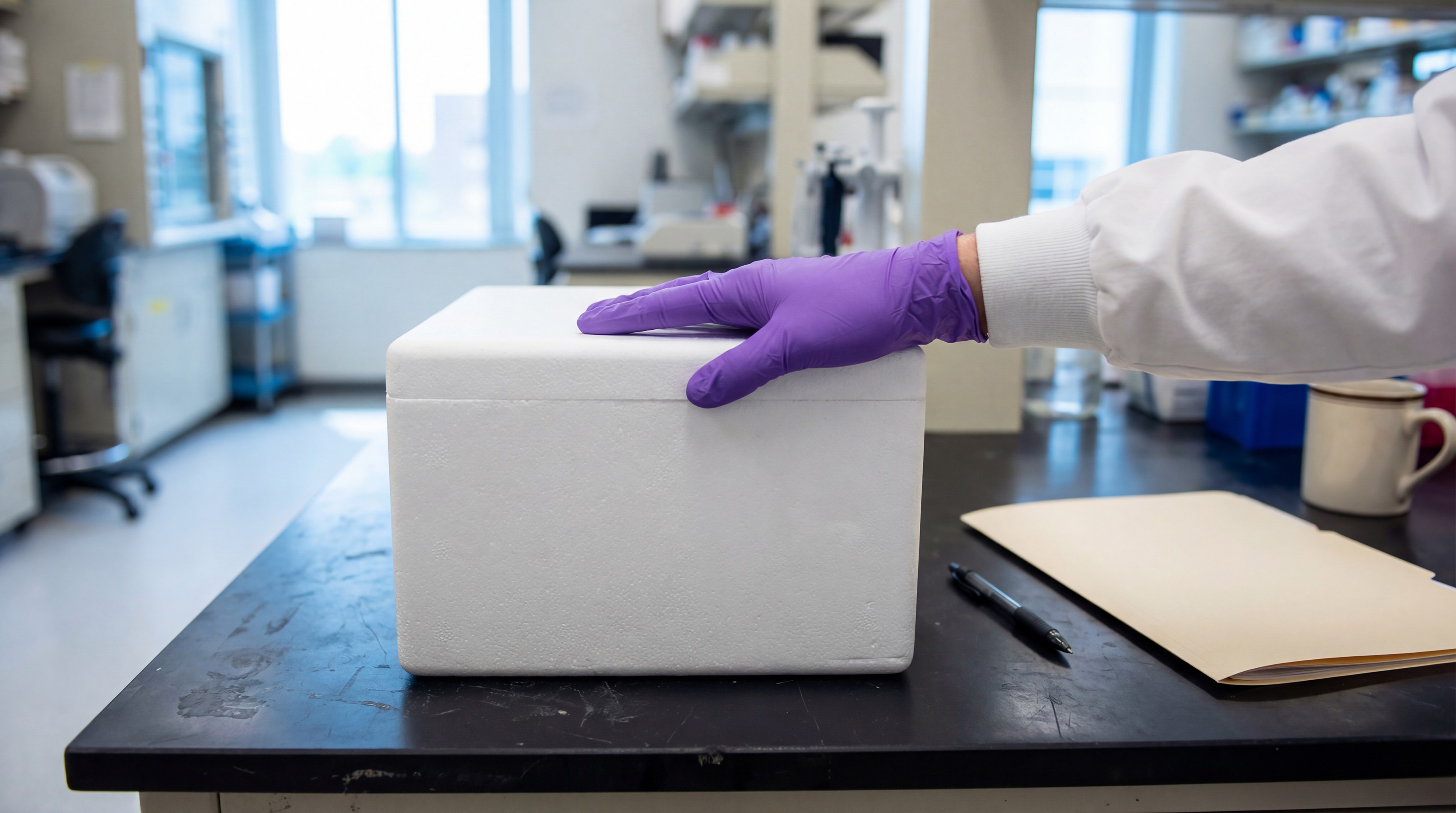
The shipment arrived at the lab at 7:42 AM, as scheduled. The temperature logs showed a clean 2-8°C throughout the trip. However, the research coordinator called three hours after delivery to deliver bad news: the cells were dead.
If you’ve been working in the cold chain for a number of years, you’ve likely experienced some version of this. “Compliant” on paper, but “compromised” in fact. And it’s in that space between what’s on paper and what actually occurred that a $50,000 therapy becomes a write off, a clinical trial is delayed, and a patient is forced to wait even longer for the treatment he or she needs.
For decades, the cold chain industry has focused on optimizing for a single question: Did the product remain in temperature range? That question is no longer sufficient.
The old playbook worked until it didn't
Success in the cold chain used to follow a playbook. Follow packout instructions based on a seasonal profile; place the product in a foam box; place gel packs or dry ice inside the foam box; send it to the destination; and upon arrival, check the temperature. If the log looks good, you’re done.
There were logical reasons for this approach, of course. It was easy to repeat and scale. Small batch shipping volume was typically limited so there wasn’t much to worry about. Regulators were concerned with the end points of a product’s journey, not with what was happening during the often-turbulent middle part. So, the industry built itself around following static instructions and regular temperature checks. "Good enough” was genuinely good enough.
What changed
The products became harder to ship.
CAR-T therapies require storage at temperatures below -150°C [1], which seemed improbable only a decade ago. mRNA vaccines educated everyone on Earth about the importance of temperature precision. A 2°C temperature variance that would have previously been a minor concern can render a cell therapy useless today. The margin for error has decreased.
Networks became more difficult to manage.
Clinical trials today can occur anywhere from patients’ living rooms to world-renowned hospitals, and biological samples must pass through 3-4 handlers from mobile phlebotomy units to laboratories. The “Last Mile” once referred to the final leg of a shipment. Today, it refers to the entire network of clinical trial participants, sites, investigators, hospitals, etc. This is a decentralized network that the previous cold chain infrastructure was never designed to manage.
Regulators became tougher on product control.
Rather than simply asking “Was the product kept cool?” auditors today are no longer satisfied with answers of “yes,” “no,” or “I don’t know.” Auditors now expect evidence that each product was under control at every point along the distribution chain. As of 2025, the Drug Supply Chain Security Act requires that fully electronic, interoperable tracking of all pharmaceutical products occurs [2], and the bar continues to rise.
The climate has stopped cooperating with the current state of affairs.
What worked well in 2015 no longer works as the summer heat records continue to beat out the previous year and supply chain disruptions become routine. Packaging validated for “normal” conditions fails when “normal” is no longer an applicable term.
The numbers tell a story. According to IQVIA Institute, the biopharmaceutical industry loses approximately $35 billion per year due to failures in temperature-controlled logistics [3]. That total includes the cost of lost product, clinical trial delay, replacement costs, wasted logistics, and root-cause analysis. These are not isolated events nor unfortunate accidents. Failures are inherent to the current system.
The question worth asking now
In 2026, success in the cold chain is no longer simply about whether the product was kept at temperature. It is about whether you can provide evidence that you maintained control over the product throughout its journey.
That means something specific. When a blizzard closes the Memphis hub, do you know where your shipments are? When a handler leaves a cooler unattended on a loading dock for 40 minutes, do you receive an alert? When the conditions surrounding your shipments begin to deviate from the norms, can you intervene prior to the deviation becoming a failure; or do you discover the failure during an investigation several days later?
Consider that initial example. The cells died; but, why? If no one was monitoring the product during transit, the investigation becomes an archaeological dig. If someone had visibility of the shipment during transit, it may have been possible to intervene. This is the distinction between “the log looked good” and “we watched it the entire way.” Between trusting that the system worked versus knowing that it did.
If no one was monitoring the product during transit, the investigation becomes an archaeological dig.
What we keep seeing in organizations that get this right
An emerging pattern among organizations that navigate this transition: they've stopped only counting excursions and now focus on measuring whether they could recover from them. They obsess over visibility. Not merely at the endpoints, but throughout every handoff, every partner, and every instant the product is outside of their direct control. They establish response protocols in advance of urgency. They consider themselves to be operating within a system, rather than individual components.
This is less about any specific technology than it is about asking a different set of questions. Rather than “what is our packaging specification?” the question becomes “what is our system reliability?” Rather than “did we comply?” the question becomes “can we prove control?”
One question you should be asking yourself in your organization: not “How many excursions did you have last quarter?” but “When was the last time someone intervened during transit?” The answer usually tells you a great deal.
Where this is heading
Products demand this shift. Regulators are continuing to push the industry toward increased standards of accountability. Economics will no longer allow companies to ignore these issues. Visibility is no longer a luxury item, but a necessity when the cost of a single failed shipment is $50,000 and/or the clinical trial associated with that shipment is weeks behind schedule.
The question is not whether the industry will undergo changes. The industry is already undergoing those changes. The question is whether your company will be a leader in this process or play catch-up.
This article represents the first in our Q1 series on System Reliability. Our next topic will discuss the differences between compliance and control.
Sources
[1] Azenta Life Sciences. "Cryopreservation Best Practices for CAR-T Cell Storage." https://www.azenta.com/learning-center/resources/cryopreservation-best-practices-car-t-cell-storage
[2] U.S. Food and Drug Administration. "Drug Supply Chain Security Act (DSCSA)." https://www.fda.gov/drugs/drug-supply-chain-integrity/drug-supply-chain-security-act-dscsa
[3] IQVIA Institute for Human Data Science. "Biopharma Cold Chain Logistics Survey," as cited in Air Cargo News, 2019.https://www.aircargonews.net/sectors/pharma-logistics/failures-in-temperature-controlled-logistics-cost-biopharma-industry-billions/