
Why most cold chain failures happen between handoffs
Temperature excursions cluster at transfer points, not during transit. Learn why handoffs are the hidden vulnerability in cold chain operations.
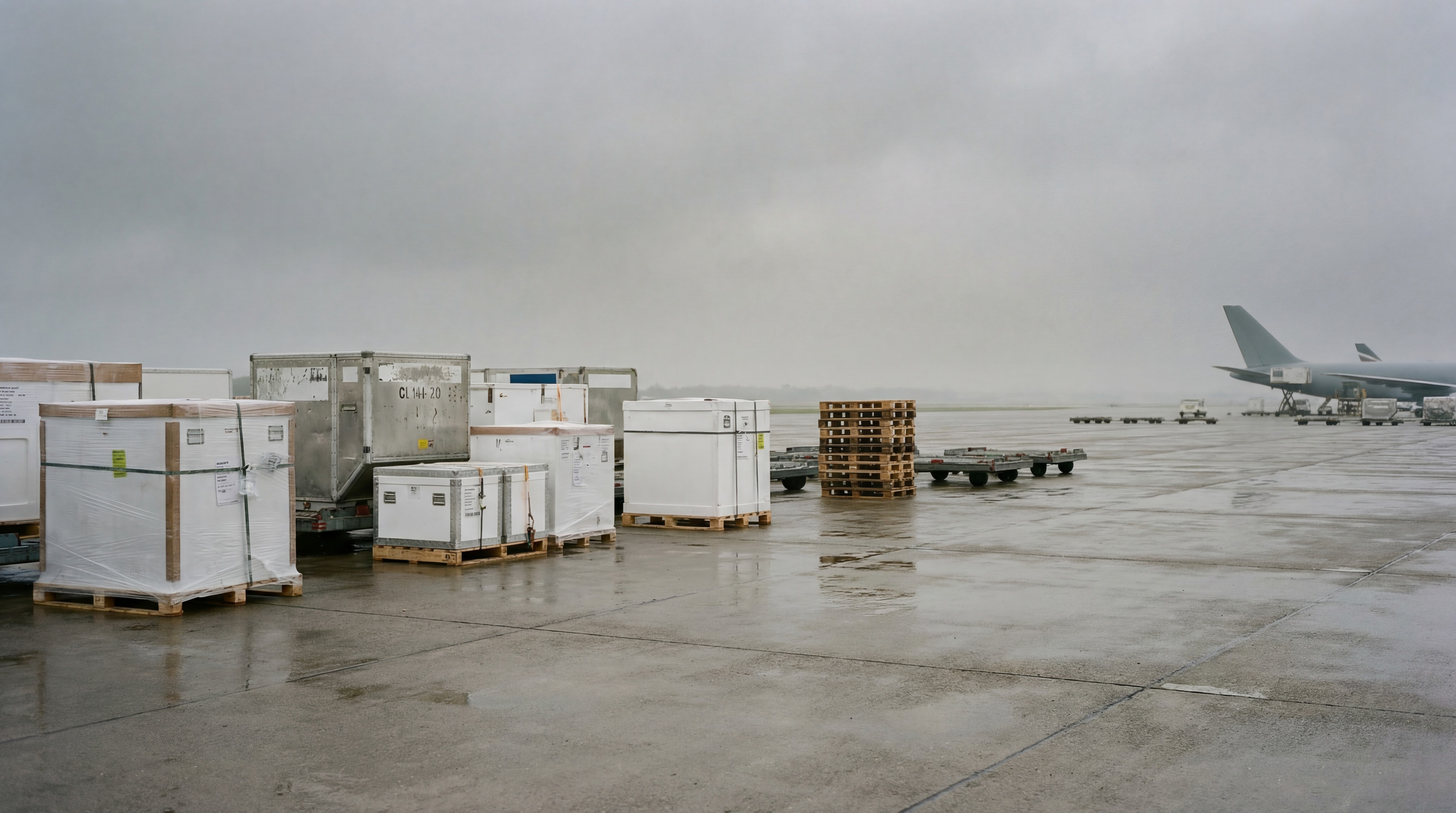
A shipment will meet all requirements for the initial and last phases of transport. The products are shipped in compliant packaging. The shippers are properly trained; and the laboratory is equipped to receive the shipments. And yet, a shipment may arrive in a compromised state.
More often than many organizations care to admit, the above scenario occurs. Organizations usually blame one of the three parties involved:
The packaging was not sufficient
The courier failed to follow instructions
The receiving dock took too long to process the shipments
But, if you look closely, you will find a completely different pattern. Failures cluster in the spaces between.
Where the data points
When researchers analyzed temperature excursions for pharmaceutical products transported via air freight, they found that the majority of excursions did not occur while the product was in transit. Instead, the majority of excursions occurred during ground operations; and the majority of those excursions occurred during the periods of time when the shipment was outside of a controlled temperature environment and being transferred from one location to another.
The broader picture supports this analysis. Industry estimates suggest that roughly 20% of temperature-sensitive pharmaceutical products are damaged or degraded during transportation. While the exact percentage varies depending upon the source, it is generally agreed that the majority of the problems with temperature sensitive products occur during the transition phases of the shipment, rather than during the longer mid-transit phases.
The numbers for vaccines are even more alarming. Estimates from the World Health Organization indicate that up to 50% of vaccines worldwide are wasted due to cold chain failures. Of those, a significant number occur during the final phase of the transportation route, which is often referred to as the "last mile." This is the portion of the shipment's route that contains the highest volume of handoffs, and often includes the most difficult logistics challenges. Up to 25% of vaccine shipments are reportedly lost during the final mile of the transportation route.
Regardless of the type of product or geographical region, the trend remains the same: handoffs are the common denominator among cold chain failures.
What happens during handoffs
To understand why handoffs lead to so many failures, let's look at a typical example of a specimen journey, and identify the handoffs that occur along that journey:
Specimen collection site to courier
Courier vehicle to depot or airport
Ground facility to tarmac to aircraft
Aircraft to ground facility at destination
Facility to final carrier
Final carrier to receiving laboratory
Receiving laboratory to processing area
Each of those transitions involves a transfer of physical custody and, theoretically, a transfer of responsibility. However, this is "theoretical."
Why handoffs create vulnerability
The problem isn't that people at handoff points lack attention to detail. Instead, it's the structure of the process.
Gaps in accountability
Between the moment one party releases a shipment and the next party formally accepts it, there's often a gap where accountability is unclear. Freight contracts rarely define ownership of the temperature outcome during that transition. As a result, when something goes wrong, everyone can reasonably point at someone else.
Gaps in visibility
Many monitoring systems track shipments during the transit phases, but not during the handoff phases. Therefore, they provide no information on whether or not a shipment experienced a major deviation during a transition.
Exposure to environmental elements
Each handoff involves physically moving the shipment from one controlled temperature environment to another, which exposes the shipment to the ambient temperature environment during the transition.
Accumulation of time
This is the sneaky one. A 15-minute delay at one handoff may seem insignificant. However, if a shipment experiences four handoffs with 15-minute delays at each, along with a delay at a sorting facility, and then a further delay at a receiving dock with insufficient staffing, the total time spent at temperatures that exceed the temperature limits of the products in the shipment becomes excessive.
Traditional solutions miss this
Most investments in improving cold chain reliability focus on the components of the cold chain, not on the connections between the components.
Packaging is validated to perform well over relatively continuous cold exposure, not during multiple transitions of the shipment during handoffs. For example, a shipper validated to maintain the required temperature for 48 hours assumes that the shipment will be exposed to continuous cold temperatures for 48 hours. However, a shipment experiencing two 24-hour segments of continuous cold exposure and four 30-minute exposure cycles at handoffs produces significantly different results. The validation protocol does not account for this difference.
Monitoring is focused on the endpoints. Traditional approaches monitor temperature at the origin and destination. If it's in range at both ends, the shipment meets the specifications. But a shipment could experience multiple excursions during handoffs and recover by arrival. The endpoint checks will miss the excursions.
Training is focused on the roles, not on the interfaces. Couriers are trained on courier procedures. Lab staff are trained on lab procedures. The handoff itself, the transition from one role to another, is often outside of the training of either the courier or the laboratory.
Standard Operating Procedures (SOPs) cover the internal processes of each organization in the cold chain. SOPs do not include shared protocols for the interfaces between organizations. The handoff is poorly defined.
Creating reliability across connections
Organizations that reduce failures during handoffs share some similar characteristics. Specifically, they focus on:
Continuous visibility across boundaries
Monitoring that continues across all transitions, not stopping once the responsibility is transferred. If the organization has visibility gaps at handoffs, that is the first item to correct. The handoff is the exact time when visibility is most important.
Explicit accountability at transitions
Accountability for the handoff window, not just "the courier has it" or "the laboratory has it." Clear protocols for the entity responsible for the handoff window.
Awareness of time-at-temperature
Understanding that the time spent during handoffs counts against the overall temperature tolerance. Creating buffer space specifically for the time spent transitioning, not just for the time spent in transit.
Protocols for recovery at transition points
Procedures for intervening at each handoff, not just at the origin and destination. What is the escalation path if a problem occurs during a transition? Who is notified? What options are available?
Practical steps to improve
If you believe that handoffs are a risk to your operation, here are some practical ways to improve:
Map your handoff points
Draw out the entire journey. Where does physical custody change hands? Where does responsibility change hands? (Not necessarily the same place.) Where is the visibility gap? Most organizations have never created a visual representation of the journey.
Track transition time
Measure the time spent on the dock, the time spent at the sorting facility, the time spent on the tarmac, etc. You may be surprised to find out how much time is spent in areas that are not monitored.
Expand monitoring through transitions
If your current system loses visibility at handoffs, that is the gap to fill first. The middle of the journey is usually fine. The edges are where the problems lie.
Coordinate with other parties
The hardest part. Working with partners to create shared protocols for transition moments. This requires relationships, not just contracts.
The chain is only as strong as its handoffs
Improving cold chain reliability is not simply a matter of improving the quality of individual components. It is also a matter of improving the connection between the components.
You can have the finest packaging, the most skilled courier, and the most competent receiving laboratory. If the handoffs between the entities are not managed, you are still vulnerable to cold chain failures.
Those organizations that successfully deliver temperature-sensitive products intact on a regular basis are the ones that have given careful consideration to those transitional moments in the shipment that others ignore as someone else's problem.
This concludes our Q1 series on system reliability. For organizations interested in exploring cold chain operations further, our Chain Reaction 2026 Report provides additional analysis on patterns for multiple product categories and geographic regions.