
A day in the life of a monitored cold chain shipment
Follow one temperature-sensitive shipment hour by hour.

What follows is a composite, built to make the ideas concrete rather than describe a specific company's shipment. It stands in for the kind of temperature-sensitive journey that runs countless times a day across pharma, food, and diagnostics. It is also a picture of the destination rather than the norm. This is what a day looks like when control, visibility, and prevention are built in. The whole point is the absence of drama. When the system is working, a shipment with one genuinely risky moment arrives looking like one that never had a problem.
6 AM, a shipment nobody will remember
A temperature-controlled shipper leaves a hospital pharmacy dock early in the morning. Inside are doses of a biologic that lives in a 2°C to 8°C window and costs more than the vehicle carrying it. The shipment has a few hundred miles to travel, a couple of legs, and at least one handoff before it reaches the clinic waiting on the other end. A coordinator, call her Dana, owns it. She has a dashboard open in a browser tab, and this shipment is one line on it.
The line reads 4.2°C and holding. That number means the shipper was conditioned and loaded correctly, the lid sealed, and the unit is talking. Three things that fail quietly and often, caught before the vehicle leaves the lot. Dana is satisfied.
The first hour nobody watches
Most temperature trouble does not start inside the validated cold room. It starts in the gaps. The loading dock. The staging area. The transfer point. The forty minutes a package sits somewhere it wasn't supposed to sit while someone finds the right cart. In most failure stories we hear, the losses cluster in between the handling far more than in equipment failure.
The shipper sits for a stretch before pickup. In an unmonitored world, those minutes are a blank space you hope was fine. Here they're a flat blue line. Same for the drive, the wait, the load. None of it needs Dana. All of it is on the record.
A warning, not an alarm
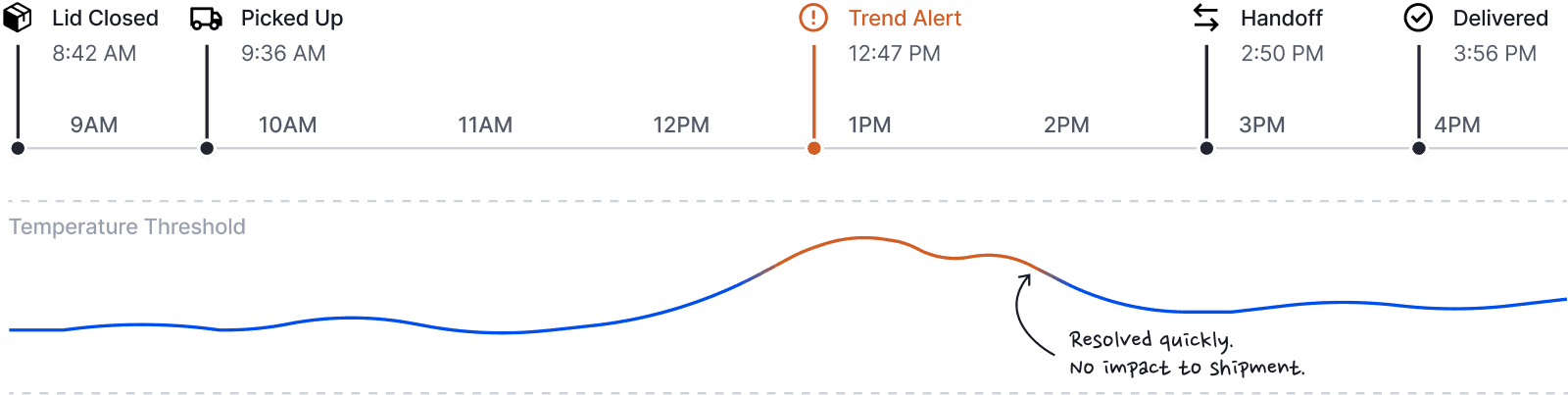
Early-afternoon, the shipper sits during transfer, its internal temperature creeping upward. Slowly and steadily. 5.1°C, then 5.4°C, then 5.8°C, trending one direction over about fifteen minutes. At 6°C, Dana's dashboard flags it. Amber, not red. The product is still comfortably in range. Nothing has gone wrong yet.
This is the distinction our last post touched on. A breach alert stays silent until the temperature crosses 8°C, at which point the shipment is already out of range and Dana is doing triage. A trend alert, however, watches the trajectory, speaking up while the reading is still fine but heading the wrong way. This approach is well established in temperature monitoring practice. The recommended habit is to set warning bands inside the acceptable range rather than at its edge, and to flag a rapid rate of change even when the absolute reading is still acceptable [1]. What it buys is time.
Dana uses it as intended. She confirms the shipment is sitting somewhere warm during the transfer and gets it moved into a temperature-controlled hold. The line peaks at 6.4°C and starts back down. It never touches 8°C. This scenario should sound familiar. It's the same kind of save we walked through in a previous post, with one difference that changes how the morning feels. There the alert fired as the temperature crossed the edge. Here it fired while there was still slack in the system.
The handoff
Later, the shipment passes from one carrier to a local courier for the final stretch. Handoffs like these are where the cold chain most reliably loses the thread. Two organizations, two systems, a package that briefly belongs to neither. In the unmonitored version, the record resets here. Whatever happened earlier becomes one party's story. Whatever happens next becomes another's. No one holds the whole thing.
It doesn't have to work that way. When the record lives with the shipment rather than with whoever is holding it, the courier picks up the same unit and the timeline keeps running on one continuous line. The morning's amber moment, the recovery, the current reading: all of it in one place, owned by the shipment rather than split across two custody logs. The handoff is still a handoff but it stops being a blind spot.
Arrival as a non-event
Later in the afternoon, the shipper reaches the clinic in range. The receiving pharmacist opens it, checks the record, sees a clean journey, and accepts the doses. Total elapsed drama, from her point of view, is zero.
This shipment had a real moment. For about fifteen minutes, the shipment veered off course. The recipient never knew, because the moment was caught before it escalated. As we’ve discussed before, a successful save is a quiet non-event. The best cold chain days produce nothing to talk about. The amber warning doesn't appear as an incident because it never became one. It shows up, if anyone ever looks, as a line that went up a little and came back down.
What made the boring day possible
Strip the story down and four things are underneath it. They are the four things this series has been about.
Control
The shipper kept its window, reporting in from the moment the lid closed.
Visibility
One continuous record traveled across every part, not resetting at each handoff.
Prevention
The trend alert turned a potential scramble into a decision made with time to spare.
And Dana
A person who acted on what she saw rather than explaining it afterward. Remove any one of those and the day gets worse. Take the alert away and the amber climb becomes an 8°C breach. Take the continuous record away and the handoff swallows the context. Take Dana away and the system is only watching itself.
Two honest caveats. Most cold chain days don't look like this yet, and the distance between the day described here and the day most shipments actually have is what we’ve been discussing recently. At the same time, none of this day is speculative. Every piece exists in the market right now. Continuous monitoring, trend alerts, a record that survives a handoff, a person with the authority to act. None of those is rare on its own. What is scarce is the assembly. All of it in place at once, working together on the same shipment.
Our battery-powered shippers carry their own monitoring with a platform that keeps a journey on one timeline. Today that work lives on the ground, in last-mile and inter-campus routes for medical couriers and hospital systems, and we're building toward more of the journey from there. The principle doesn't change from one leg to the next. The goal is a day worth forgetting.
One last thing. Look at how much of today was data. Hundreds of temperature readings. A stream of location pings. Every handoff logged. One shipment, one day, produced more information than a clipboard could hold in a month. That's fine when it's one line on Dana's dashboard. The next post asks what happens when it's ten thousand shipments a year, and why, at that scale, reliability quietly turns into a data problem.
Talk to our team about real-time visibility for last-mile and inter-campus cold chain.